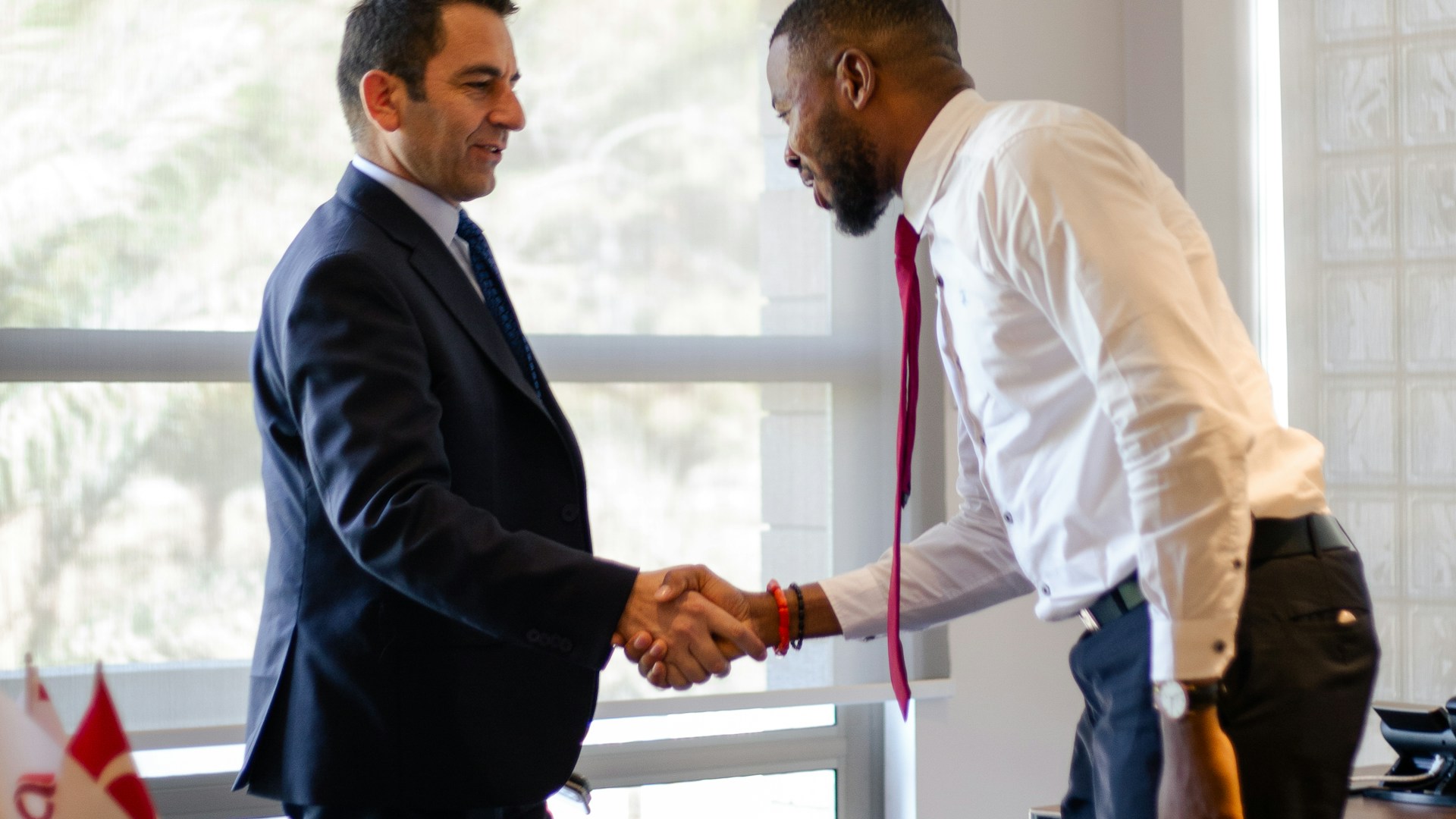
France scores 68 out of 100 on Hofstede's Power Distance Index, noticeably higher than the UK (35) or the US (40). That number is a measure of how much a culture accepts hierarchy, and in practice it means French offices still care about who speaks first, who gets a title, and how you say your own name. Walking into a French meeting with an English-style "Hi, I'm Sarah, great to meet you" reads as a little too casual before you have exchanged a word about who is in charge.
How do you introduce yourself in a French meeting?
Give your name, your role and your company, in that order, before anything else. The standard formula is short and does not need decoration:
- "Bonjour, je m'appelle Claire Dubois, je suis responsable marketing chez Lumière." (Hello, my name is Claire Dubois, I'm marketing manager at Lumière.)
- "Enchanté(e), je travaille au service commercial." (Pleased to meet you, I work in the sales department.)
- "Je suis en charge du projet dont on va parler aujourd'hui." (I'm in charge of the project we're discussing today.)
Say "enchanté" if you are a man, "enchantée" if you are a woman, it means "pleased to meet you" and works in almost any professional context. Keep small talk for after the introductions, not instead of them. If you are joining a call rather than a room, the same order still applies, name your role before you dive into the agenda, even if someone will introduce you first.
How formal should your introduction be, tu or vous?
Default to vous until someone explicitly tells you to switch, and never guess based on age or how relaxed the room looks. French offices, including startups, still expect vous with clients, with anyone senior to you, and with anyone you are meeting for the first time. Using tu too early is one of the fastest ways to sound like you skipped a step in the language, not just the culture.
| Situation | Use | Example |
|---|---|---|
| First meeting with a client | vous | "Vous avez pu consulter le dossier ?" |
| Established team, same level | tu, if invited | "Tu as vu le dernier mail ?" |
| Talking to your manager | vous, unless told otherwise | "Vous préférez qu'on avance sur ce point ?" |
| Internal startup chat, after introductions | often tu | "On se tutoie, ça te va ?" |
That last line, "on se tutoie, ça te va ?" (shall we use tu, is that okay with you?), is the polite way someone offers to drop the formality. Wait for it rather than initiating it yourself.
What do you say when introducing someone else?
Present the other person before yourself when you are the one making introductions, and always give their function, not just their name. This matters more in France than it does in English, where a first name is often enough.
- "Je vous présente Marc Petit, notre directeur technique." (Let me introduce Marc Petit, our technical director.)
- "Voici Amina, elle gère le compte depuis six mois." (This is Amina, she has managed the account for six months.)
- "Vous vous connaissez déjà, je crois ?" (I believe you already know each other?)
If you are the most junior person in the room, it is usually not your place to make the introductions unless the meeting host asks you to. When you are the one being introduced, a short nod and "enchanté" is enough, resist the urge to add your own résumé on top of what has just been said about you.
What should you avoid saying?
Skip anything that assumes familiarity before it has been granted, even if it would sound friendly in English. A few common missteps:
- Do not open with "Salut" in a first professional meeting, it is reserved for people you already know informally.
- Do not ask personal questions ("Vous êtes marié ?") as an icebreaker, French professional small talk stays closer to work, travel or the weather.
- Do not use someone's first name alone before hearing them use yours, especially with a client or someone senior.
- Do not interrupt the introduction round to jump straight to business, let the host finish the round first.
Getting this order right in the first ninety seconds of a meeting sets the tone for how seriously you are taken for the rest of it.
Practising these openings out loud, with real feedback on tone and formality, is where most learners notice the biggest gap between textbook French and the French actually spoken in a meeting room. Yann, a certified French teacher, runs one-to-one lessons built around exactly this kind of professional situation, and a free trial lesson at frenchwithyann.com is the easiest way to find out where your own French still sounds a step too casual, or too stiff, for the room you are walking into.
Common questions
Do I use my first name or last name when I introduce myself in French?
First name is standard today, even in formal meetings, but give both if you can: 'Je m'appelle Claire Dubois.' Colleagues will then choose how to address you, usually by first name once vous is established.
Should I shake hands with everyone in a French meeting?
Yes, one handshake per person when you arrive, not a group wave. In some offices a cheek kiss (la bise) happens between people who already know each other, but never on a first professional meeting, a handshake is always safe.
Is it rude to use tu in a French business meeting?
Yes, with anyone you have not been explicitly invited to tutoyer. Default to vous with clients, senior colleagues and anyone you are meeting for the first time, even in a casual startup.