Learn French online, from A1 to C2

One-to-one French lessons, A1 to C2. Whatever brought you here, the lessons are built around it.

Why are you learning French?

Your reason decides what we practise first. Here is how the lessons change for the most common ones.

You are moving to France

Landlords, the prefecture, the doctor, the neighbours. We practise the conversations you will actually have in your first months, including the phone calls that feel hardest, and the forms and emails behind them.

Your partner or in-laws speak French

You follow the first sentence and lose the rest, because the family speaks fast, interrupts and jokes. We work on the French of the dinner table: how people really talk, slang included, and how to join in without rehearsing first.

You have plateaued

You know the words and still freeze when someone answers. We find the structures that keep breaking, usually the past tenses and the subjunctive, and fix them by speaking, not with another grammar book.

You learned it at school and it faded

The grammar is still in there somewhere. We wake it up fast, skip what you remember and get you speaking within the first lessons. A level test shows where to restart.

You spend time in France

A holiday home, long stays or family you visit every year. You want to chat with the neighbours, follow the village meeting and stop switching to English. We build everyday ease first.

You want films, books and ideas in the original

Subtitles flatten the jokes and translations flatten the style. We read and watch real material, learn the register and idiom behind it, and talk about it, so French becomes something you enjoy rather than study.

You need it for work or an exam

General French is the base. If your goal is meetings and emails, or a DELF, DALF, TCF or TEF result, there are dedicated tracks: business French and exam preparation.

Written while teaching

Self-authored

I wrote every grammar point, worksheet and example sentence myself, and I've reworked them after each year of teaching.

Level-appropriate

At A1 you get the French you need to get by, fast. B1 and B2 fix what keeps intermediate learners stuck. C1 and C2 are about tone, nuance and idiom.

Honest correction

I correct you as you speak, and I tell you plainly what is holding your French back. No empty praise, and no pretending a mistake does not matter.

What the course covers

My lessons are built on two books I wrote myself. Here is what is inside, chapter by chapter. The pages themselves are for students.

A1 – A2

Beginner course book

Explanations in English, examples in French.

51
lessons
7
study sheets
30
verbs in 8 tenses
Sounds and spelling2
  • Pronunciation: vowels, consonants, liaisons
  • The alphabet and accents
Foundations (A1)10
  • Numbers, dates and days
  • Subject pronouns and être
  • Articles and nouns
  • Avoir and the family
  • Adjectives: agreement and position
  • Possession
  • Regular -er verbs
  • Partitive articles
  • Negation
  • Review 1, with answers
Everyday life7
  • Asking questions
  • Reflexive verbs and daily routine
  • Around the house
  • Directions and getting around
  • Shopping and money
  • Aller and the near future
  • Review 2, with answers
Telling stories8
  • The passé composé
  • Food and restaurants
  • Describing people and places
  • The imparfait
  • Talking about the weather
  • Linking ideas: parce que, mais, donc
  • Faire and prendre
  • Review 3, with answers
Communicating (A2)14
  • Telling the time
  • Giving and asking for opinions
  • Reflexive verbs in the past
  • Jobs and work
  • Making plans
  • The imperative
  • Appointments and invitations
  • Emotions and preferences
  • Talking about past trips
  • The future tenses
  • Comparing things
  • Describing events in order
  • Forms, offices and admin
  • French culture and idioms
Going further4
  • Direct and indirect object pronouns
  • Adverbs of manner and frequency
  • Relative pronouns qui, que, où, dont
  • Verbs in -ir
Themes9
  • Leisure and interests
  • Travel and public transport
  • Health
  • Technology
  • Events and celebrations
  • Everyday objects
  • Feelings
  • Problems and solutions
  • The environment
Reference and study sheets6
  • 30 essential verbs in 8 tenses
  • Irregular past participles
  • Every tense at a glance
  • Imparfait or passé composé?
  • Prepositions
  • Negation and possession
B1 – C1

Advanced workbook

Written entirely in French.

22
chapters
10
topic units
70+
idioms
Grammar and tenses9
  • Imparfait and passé composé
  • The plus-que-parfait
  • The conditional, present and past
  • Futur simple and futur proche
  • The futur antérieur
  • The present subjunctive
  • The past subjunctive
  • Modal verbs: pouvoir, devoir, vouloir
  • Participles and the gerund
Sentence structure9
  • Pronouns, including y and en
  • Relative pronouns, simple and compound
  • Demonstrative pronouns
  • Prepositions of place and time
  • Adverbs
  • Adjectives: agreement and position
  • Logical connectors
  • Negation
  • Purpose, cause and concession
Expression4
  • Giving and defending an opinion
  • Idioms, with their literal translation
  • Spoken and informal French
  • Writing concisely: reports, summaries, formal emails
Topic units10
  • Social media and relationships
  • Equality between women and men
  • Remote work
  • Stress in modern life
  • Zero waste
  • An ageing population
  • Religion in modern societies
  • Culture and identity
  • Contemporary French cinema
  • Engaged literature
  • and 40 debate questions
Free study sheet

Try a page from the course book

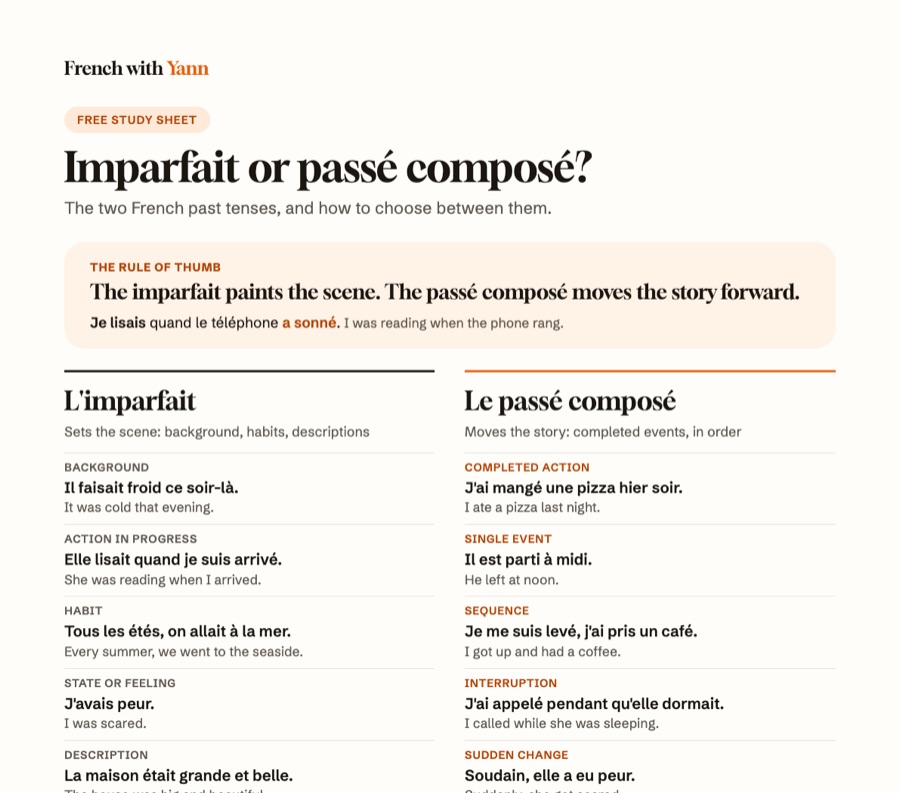
Imparfait or passé composé? Every learner asks, so here is my answer on one page: when to use each tense, the signal words that give it away, and four sentences to test yourself. Print it and keep it, no email needed.

The top half of the study sheet: the rule of thumb, then the imparfait and the passé composé side by side, with examples.

Not sure where you would start? Take the 3-minute test, and we pick your first chapter together in the free trial lesson.

Where you are on the CEFR scale

A1 – A2

You can introduce yourself, order, ask for directions and follow slow, clear speech. Core grammar and real conversation start in the first lesson.

B1 – B2

You can handle most situations, give opinions and follow a normal conversation. This is where the plateau lives: the tenses and structures that trip most learners up, sorted out properly.

C1 – C2

You speak fluently and the work is polish: register, nuance, idiom, and French that stops sounding like a textbook.

Questions about learning French with me

Can I learn French online with a private tutor if I am a complete beginner?

Yes. At A1 we start with the French you need to get by, in one-to-one lessons, and you speak from the first session. Online lessons suit complete beginners because you are corrected immediately and every minute is about you.

How do I know which level I am?

Levels follow the CEFR scale, from A1 to C2. The free 3-minute level test gives you an estimate, and the free trial lesson confirms it by talking, which is more reliable than any quiz.

Do the lessons change depending on why I am learning French?

Yes. The grammar order stays the same underneath, but the examples, vocabulary and speaking tasks follow your reason: moving to France, family, a second home, culture, work or an exam.

How often should I have lessons?

Once a week is a steady pace and twice a week is faster. What moves you forward most is the French you use between lessons, so we agree small things to do in between.

Will the lessons be in French or in English?

In French from the start, at a level you can follow. I explain in English when a point needs it, then bring you back to French.

Who are the lessons for?

Learners at every level, from first-time beginners to near-native speakers. The examples, the pace and the topics are built around your reason for learning French.

Is the first lesson really free?

Yes. The first lesson is free and there is nothing to cancel. We talk, I hear where you are, and you leave with a plan whether or not you book again.

Start where you are

The first lesson is free. Tell me why you want French and we find your level and plan from there.

Book a free trial