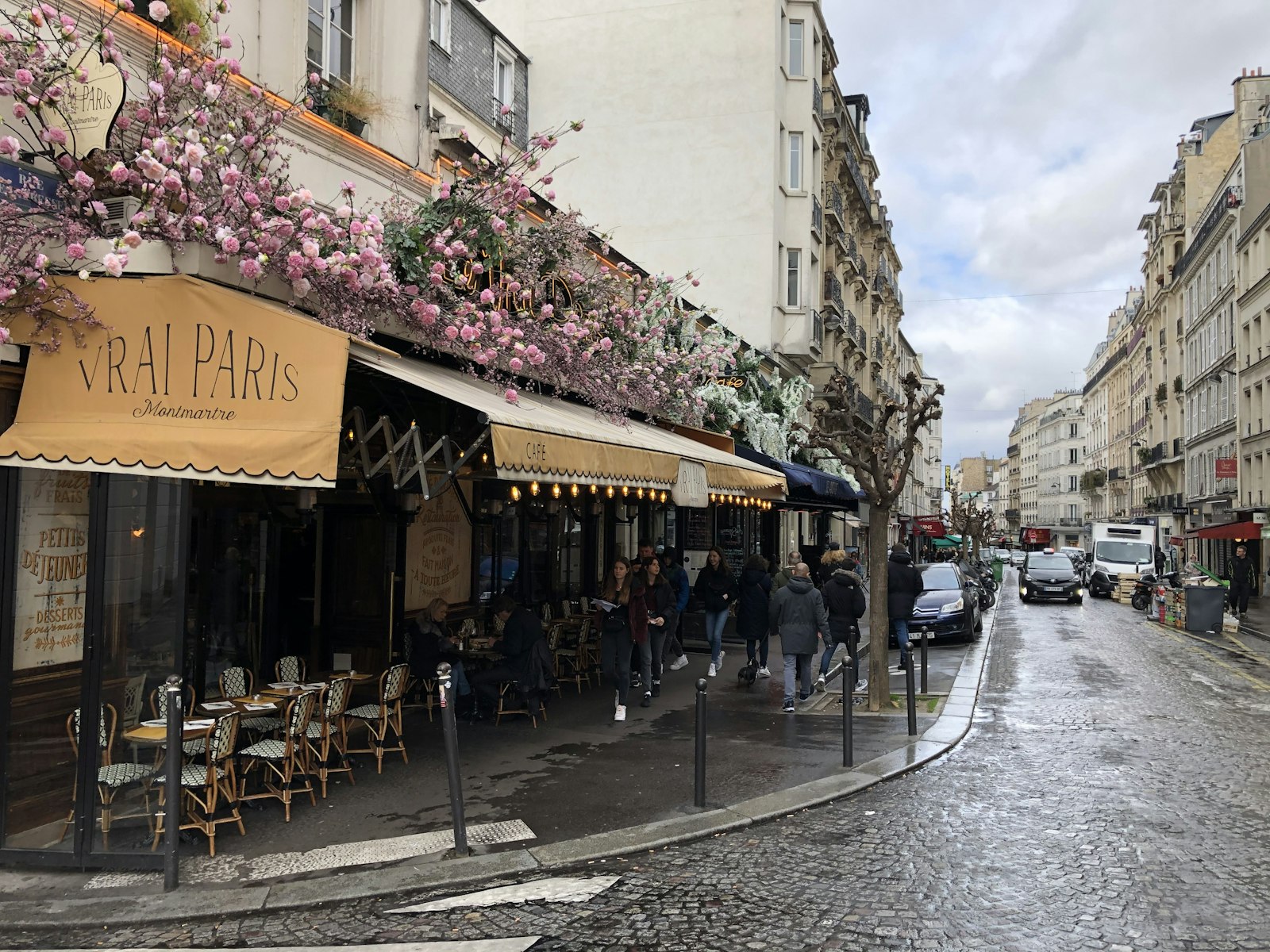
Paris welcomed over 18 million international visitors in 2025, according to Euromonitor International's Top 100 City Destinations Index, which ranks it the world's leading city destination. That is a lot of people trying the same few sentences at the same café counters. The ones who get a warm reply are rarely the ones with the best accent. They are the ones who know the right opening line. Here are forty phrases, grouped by the stops on a walk through the city.
How do you greet people and stay polite in Paris?
Say bonjour first, every time, before any question or request. In France, greeting someone when you enter a shop or office is expected, and skipping it is read as rude. Add Madame or Monsieur and you sound even better.
- Bonjour, Madame / Monsieur. (Hello.)
- Bonsoir. (Good evening, used from late afternoon.)
- S'il vous plaît. (Please.)
- Merci beaucoup. (Thank you very much.)
- Excusez-moi. (Excuse me, to get someone's attention.)
- Pardon. (Sorry, when you bump into someone.)
- Bonne journée ! (Have a good day, when you leave.)
- Au revoir. (Goodbye.)
What do you say in a café, a bakery or a restaurant?
Use je voudrais (I would like) instead of je veux (I want), and finish with s'il vous plaît. Je veux is correct French but sounds blunt, like a demand.
- Une table pour deux, s'il vous plaît. (A table for two, please.)
- Je voudrais un café crème. (I would like a coffee with milk.)
- Je vais prendre une baguette. (I'll take a baguette.)
- Qu'est-ce que vous recommandez ? (What do you recommend?)
- Est-ce qu'il y a une option végétarienne ? (Is there a vegetarian option?)
- L'addition, s'il vous plaît. (The bill, please.)
- Je peux payer par carte ? (Can I pay by card?)
- C'était délicieux, merci. (It was delicious, thank you.)
| Blunt | Natural |
|---|---|
| Je veux un café. | Je voudrais un café, s'il vous plaît. |
| Où est le métro ? | Excusez-moi, où est le métro, s'il vous plaît ? |
| Vous parlez anglais ? | Bonjour. Je parle un peu français. Vous parlez anglais ? |
How do you ask for directions and use the métro?
Start with excusez-moi, then ask where the place is, and listen for the key words: tout droit, à gauche, à droite. Most answers are short, and these three cover nearly all of them.
- Où est la station de métro la plus proche ? (Where is the nearest métro station?)
- Pour aller à la tour Eiffel, s'il vous plaît ? (How do I get to the Eiffel Tower, please?)
- C'est loin d'ici ? (Is it far from here?)
- C'est tout droit ? (Is it straight ahead?)
- Je tourne à gauche ou à droite ? (Do I turn left or right?)
- Quelle ligne faut-il prendre pour Montmartre ? (Which line do I take for Montmartre?)
- Où est-ce que je peux acheter un ticket ? (Where can I buy a ticket?)
- Je descends à la prochaine. (I'm getting off at the next stop, said to people blocking the door.)
How do you shop and visit sights in French?
Greet the person first, then ask your question in a full, polite sentence. In small shops, the greeting matters more than the vocabulary.
- Je regarde seulement, merci. (I'm just looking, thank you.)
- Vous avez ça en taille M ? (Do you have this in a medium?)
- Je peux l'essayer ? (Can I try it on?)
- Combien ça coûte ? (How much does it cost?)
- C'est ouvert jusqu'à quelle heure ? (Until what time is it open?)
- Un billet, s'il vous plaît. (One ticket, please.)
- Est-ce qu'on peut prendre des photos ? (Are we allowed to take photos?)
- Vous pouvez nous prendre en photo ? (Can you take a photo of us?)
What do you say when you do not understand?
Say so plainly and ask for a slower repeat: je ne comprends pas is a complete, useful sentence. Nobody minds, and it keeps the exchange in French longer than switching to English does.
- Je ne comprends pas. (I don't understand.)
- Vous pouvez répéter, s'il vous plaît ? (Can you repeat that, please?)
- Vous pouvez parler plus lentement ? (Can you speak more slowly?)
- Comment dit-on « bridge » en français ? (How do you say "bridge" in French?)
- Je parle un peu français. (I speak a little French.)
- Je suis perdu(e). (I'm lost. Add the e if you are a woman.)
- J'ai besoin d'aide. (I need help.)
- Où sont les toilettes ? (Where is the toilet?)
Use vous with everyone in these situations. Our guide to tu or vous explains the rule and the exceptions. And if the answers come back too fast to follow, that is normal: the gap between what you read and what you hear is trainable, and we explain how.
Conclusion
Forty phrases will carry you through a day in Paris, but reading them is not the same as saying them at speed, with a stranger waiting. The fastest way to make them yours is to practise out loud with a native speaker before you go. Yann is a certified French teacher who prepares learners for exactly these situations, with spoken practice of the café, the métro and the shop counter. Your first lesson at frenchwithyann.com is free, and it is enough to find out which of these phrases you can already use.
Common questions
Is it rude to speak English in Paris?
Not in itself. What matters is how you start: a bonjour, then a few words of French, then your question. Even if the conversation switches to English, that opening changes how you are received.
Should I use tu or vous with people in Paris?
Use vous with anyone you do not know: waiters, shop staff, strangers asking or giving directions. Tu is for friends, family and children. If you are unsure, vous is always the safe choice.
How long does it take to learn 40 French phrases?
A few short sessions are enough to recognise them, and a week of saying them aloud is enough to use them. Learn one group at a time, and say each phrase out loud rather than only reading it.